Three Partners
Mariners' Museum, Uncurated Search Results
Type: Skipjack
Year: 1899
Builder:
Location: Pocomoke City

These records are found in the online catalog of The Mariners’ Museum and Park in Newport News, Virginia. Uncurated search results are presented to give researchers and interested readers an idea of whether the museum’s archives contain information about this vessel and whether it may be worthwhile to visit the museum’s catalog search page for further investigation. Uncurated results may be inaccurate or incomplete.
Search mode: Exact Name. Search phrase(s): "Three Partners". Results returned: 1. Results displayed in this table: 1.
Use these buttons to send uncurated search results to your own app or text document for further research. First, check the box for any row, or click "Select All" then uncheck any rows. Then click "Show Selections". You can then copy your selections from the text box and past them into your app.
| Fetch? | Row ID | Media | Date | Vessel | Place | Related Places | Inscription/Marks | Subject | Notes | Archive Number |
|---|---|---|---|---|---|---|---|---|---|---|
| 1 | 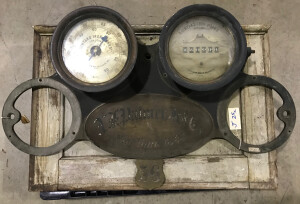 | SHORT DESCRIPTION: Engine gauge frame by N.F. Palmer Jr. & Co. in New York with an American Steam Gauge Company, No. 1 T. W. Lane steam gauge, and an engine register manufactured by the same company. The gauges are attached to a wooden panel from over cabin window frame from the side-wheel ferry Atlantic. NOTES: The "T.W. Lane steam gauge" refers to a historically significant double-spring pressure gauge invented by Thomas W. Lane. Patented on February 22, 1859, Lane's invention (Patent No. 23,032) was manufactured and marketed by the American Steam Gauge Company of Boston. NOTES: The Quintard Iron Works existed in New York City from approximately 1869 until WWI. The origins of the company are with T.F. Secor & Co., which started in 1847 with three partners. Charles Morgan was one, and he eventually took over the company and renamed it the Morgan Iron Works. George W. Quintard married Francis E. Morgan in February 1843 and by 1851 the city directories have him working for his father-in-law, Morgan, where he rose quickly in the company. Quintard stayed with Morgan Iron Works through 1865 (according to city directories), but his obituary reports that he was president of the New York & Charleston Steamship Company by 1867 and founded the Quintard Iron Works two years later. According to Transactions from the Society of Naval Architects and Marine Engineers Quintard brought on his son-in-law, Nicholas F. Palmer, Jr., as a partner in 1873. Kenneth Blume’s book Historical Dictionary of the U.S. Maritime Industry states that Quintard then started the New York & Charleston Steamship Company in 1875, sometimes referred to as the Charleston Line or the Quintard Line. They operated the wooden steamers City of Columbia, City of Palatka, and City of Alaska. That company lasted until 1888 when the ships were sold to the Clyde Line and the Alexandre Line. By 1885 Palmer started his own company, N.F. Palmer Jr. & Co., as seen by the date on the object. He was the manager of Quintard and appears to have taken control of that company and operated it as a subsidiary of his own company, hence both names appearing on the gauges. Several places refer to machinery being built by “N.F. Palmer Jr. & Co’s Quintard Iron Works.” They built the machinery for USS Maine, which later exploded in the Havana Harbor. Around 1904 Palmer merged the two companies and incorporated them. George Quintard died in 1913 leaving an estate of over $2.2 million, and Palmer sold the company around 1917 to William H. Todd who merged several companies to create Todd’s Shipyard Corporation. VESSEL INFORMATION-- VESSEL NAME: ATLANTIC VESSEL TYPE: side-wheel ferry SERVICE DATES: 1885-1939 BUILDER LOCATION: New York, Brooklyn VESSEL DIMENSIONS: 197 x 36 x 13.6; 930 gross tons, 736 net tons PLACE OF DISPOSAL: East Kinston DATE OF DISPOSAL: May 9, 1939 | CL2779 |
Created 2026 by Don Barker, CBMM volunteer, for the Chesapeake Shipbuilding Project. shipbuilding@sailingworkboats.es